

The Plate
A boy remembers the difference between correction and shame.

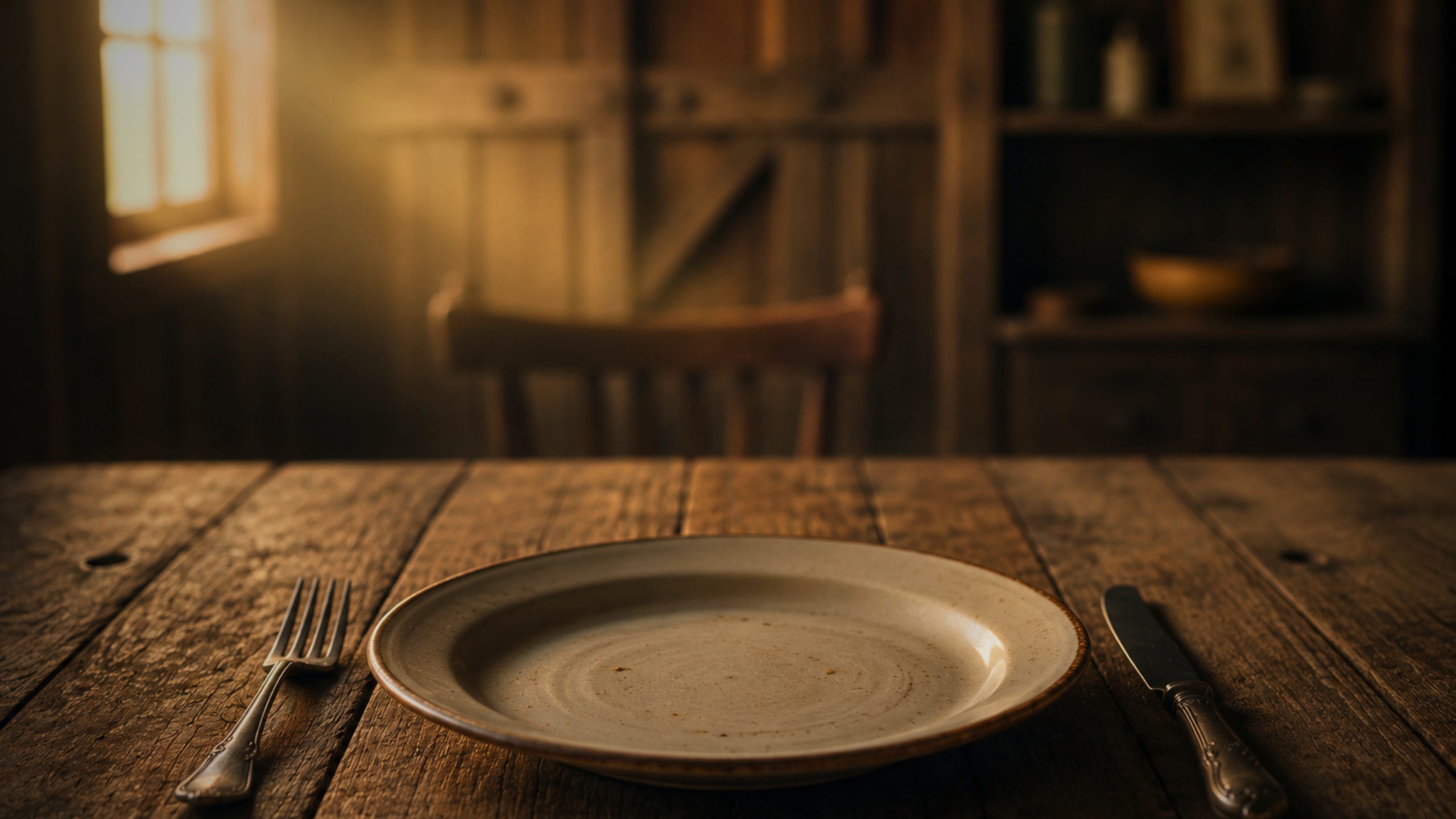
The plate was never just about food.

I remember a Christmas not long after I arrived in the United States in the late 1990s. My American grandma had known me for maybe four years at that point, and dinner was being served.
It was different for me.
In the Vietnamese household I knew, everyone came together and ate at a certain time, but it was not like this.
This felt different.
Everyone had their own plate.
Everyone was choosing what they wanted.
Mashed potatoes.
Gravy. Corn. Chicken. Salad.
Maybe a dinner roll and even stuffing, though I probably did not even know what stuffing was yet.
These were foods that probably felt normal to everyone else,
but to me they felt like a different language on a plate.
My palate was still Vietnamese.
Rice.
Soup.
Fish sauce.
Broth.
The food I knew. The food that felt like home.
I remember filling my plate
with a lot of food.
Not because I was that hungry.
But because I wanted to fit in.
Everyone else had a plate…
so I wanted one too.
But after I sat down… I realized I was not really eating much.
And I remember my grandma sitting beside me, chatting with her family and friends, but still noticing.
Somehow, even in a room full of people
and laughter, she still saw me.
That is the part I remember.
She did not make a scene.
She did not embarrass me.
She did not turn my plate into proof
that I had done something wrong.
She just leaned in and whispered…
“You do not have to eat till you are full. Just eat till you are finished.”
I do not think I understood how much wisdom was in that when I was younger.
I just knew how it felt. It did not feel like shame. It did not feel like judgment.
It did not feel like I was being watched for proof that something was wrong with me.
She was teaching me the difference between enough and too much.
And…that was it.
There was love in the correction.
That is something I think about a lot now after her passing.
Because not every correction
feels like love.
Some correction makes you feel guided.
Some correction makes you feel
guilty for existing.
My grandma could tell me to stop eating…
without making me feel
like I was too much.
She could say enough
without making me feel unwanted.
She could remind me
without making the room feel smaller.
And maybe that is why her words continue to stay with me.
Because she was not
just teaching me how to eat.
She was teaching me how love sounds when it is trying to help you.
I call her my American grandma,
but I also call her the love of my life.
Because she gave me something
I did not know I was looking for here.
A room. A plate.
A place where I still felt wanted.

Unfortunately, there were other voices
that did not feel like hers.
But I want to be fair here.
Food was not a small thing in my family.
We were immigrants from a country still carrying the wounds of a horrifying war.
A war that left many people dead.
Families broken. Dreams shattered.
And an economy in pieces.
My Vietnamese grandma
understood that in a way…
I probably could not fully understand as a child.
She made the journey from the North of Vietnam to the South with all of her children. During a time when artillery shells were landing and a full-blown war was going on.
And because she made that journey, I am able to sit here and write this.
So I am grateful. I am grateful for her survival. I am grateful for her sacrifice.
I am grateful that she carried her family
through something I can only try to understand.
So when she taught us not to waste food.
Not to waste water,
and she would often hide valuables.
Sometimes to the point she would forget
where she hid them.
I understood at a young age that —
that lesson came from somewhere real.
When all you had to eat was a ration of plain rice split between you and your children, then food is no longer just food.
It becomes survival.
Food meant gratitude.
It meant remembering that
someone before you may have gone without.
That lesson makes sense to me.
And…I respect that lesson.
I want to be clear about that.
The lesson was not what hurt me.
That part was never the wound.
The wound was when that lesson was used differently.
When my mother took something rooted in survival and gratitude,
and turned it into a word placed on me.
”Wasteful.”
That is the translated word from Vietnamese that I remember.
It wasn’t taught. It wasn’t guided.
It was a label.
And when a child is labeled enough…
he starts to wonder if the word is really about the food anymore.

There were times during my childhood when food felt like a test.
There were times when a plate felt heavier than a plate should feel.
I remember being called wasteful as a child.
Not because I threw away some huge meal.
Or because I did not care.
But because I did not eat every little piece of chicken off the bone.
That was enough to become a lesson about who I was.
…Wasteful.
That word can do something to a child,
especially when it is not used evenly.
Children notice more than adults often give them credit for.
From their smaller perspective…
the world is a lot bigger, and things are often magnified.
They notice when one child’s
plate becomes evidence
and another child’s plate
is allowed to just be a plate.
They notice when one child
has to finish everything
while another child does not.
They notice when the rules
are not really rules.
They are measurements.
And you already know where you stand before anyone says it out loud.

I do not want to name names here.
That is not the point of these pieces I share.
The point is not to turn memory into revenge.
The point is the feeling.
The point is being a boy at a table,
and realizing…
that the same mistake
can mean different things
depending on who makes it.
For one child, not finishing food
is just not finishing food.
For another child, it becomes proof.
Proof that you are careless.
Proof that you are ungrateful.
Proof that you take too much.
Proof that you waste what you were given.
And… when you hear that enough you start to wonder if they are still talking about the food. Or if they are talking about you.
That is the part I understand differently now.
Because I do not think
the plate was ever just about the plate.
The plate would grow into a place
where I learned how I was seen.
Or… maybe how I was not seen.
What did I know? I was a child.
I did not know how to explain why:
one child’s needs seemed normal
and another child’s needs seemed like a burden.
I did not know how to say…
“Why do I have to finish everything when he does not?”
I just knew it felt different.
I just knew the table was not round.
And that there were sides…
but I always knew which side I was on.

Maybe that is why I remember the light too.
My stepfather used to get mad when I turned on the light.
Something that should have been simple.
Something a child should not have had to think about.
But even that could become too much.
At first it was— too much electricity.
But it became, too much noise.
Too much space. Too much need.
And it is hard not to connect that to the basement.
Because the same person
who got mad about the light
was the same person
who put me in darkness.
That is what I understand now.
It was never just about the light.
It was never just about the plate.
It was about control.
It was about making a child feel like he had to shrink…
before he could even grow.
Do not eat too much.
Do not leave too much.
Do not turn on the light.
Do not need too much.
Do not be too much.
That is a heavy thing for a boy to carry.
Because after a while…
you stop asking for certain things.
You stop turning on the light.
You stop reaching for more.
You start measuring yourself
before anyone else can.
You start wondering
if your needs are too expensive.
You start wondering
if your presence costs too much.
And you start to look at the people around you
like they don’t see you.
And…maybe that is what shame does.
It takes something small
and turns it into a mirror.
A plate becomes a mirror.
A light switch becomes a mirror.
A chicken bone becomes a mirror.
And somehow…
every mirror says the same thing.

I do not know if anyone ever said it clearly.
Maybe… they did or maybe… they did not.
But children do not always need the exact
words to understand where they stand.
Somewhere along the way…
I started to feel like I was the child who interrupted a life.
And someone else was the child that life had made room for.
That is a painful thing to realize.
Not because children understand everything…
But because children often feel everything before they can name it.
When a room tightens around them.
When someone’s patience
is shorter with them.
When their mistakes
are treated like character flaws.
When love has conditions
they did not agree to.
And sometimes, they carry those feelings
long after the meal is over.
That is why I keep coming back to my grandma.
Because with her…
the plate was not evidence against me.
It was just a plate.
The food was just food.
The lesson was just a lesson.
And love never left the room.

My grandma never taught me to shrink.
She taught me to listen.
There is a difference.
When she told me not to eat
until I was full.
She was not saying
I was wrong for being hungry.
She was not saying I was wasteful.
She was not making
my body feel like a burden.
She was teaching me… that enough was enough.
That is care.
That is guidance.
That is love with a hand on your shoulder,
instead of a finger in your face.
She could stop me—without breaking me.
She could correct me—without humiliating me.
And..she could say no
and still leave love in the room.
That is not a small thing.
That is the kind of thing a child remembers forever.
Because some people correct you in a way
that makes you afraid to make mistakes.
And some people correct you in a way
that makes you feel safe enough to grow.
My grandma was the second kind.
She just loved me enough
to show me when to stop.

I think about that now as a father.
Because I know
I will have to correct my sons.
I have to…
because love without guidance
is not really love.
But I will never yell at my sons
for not finishing their food.
I cannot.
It’s not…
because I want them to waste things.
Or… I somehow do not care
about teaching them gratitude.
But it’s because…
I remember what it felt like
when a plate became shame.
When food was no longer just food.
When not finishing something
became proof that something was wrong with me.
And I never want my sons to feel that from me.
So when they do not finish their food,
I try to teach them without making them feel small.
I ask to make sure they are full,
because kids can get playful
and not want to eat.
I often remind them…
not to take more than what they need.
That food matters more to some than others.
And that’s okay.
And I remind them that we should be grateful.
But I do not want gratitude
to sound like shame.
I do not want my voice
to turn into the voice
they carry for the rest of their lives.
I do not want a plate to
become proof that they are bad.
I do not want a light switch to become proof that they are asking for too much.
I do not want my sons to feel like their needs make them a burden.
And…maybe that is why
I ask them if they are okay so much.
Sometimes…
I think I probably ask too much.
But I also know…
what it feels like to be a child who is not asked.
I know what it feels like to be quiet…
and still need someone to notice.
I know what it feels like to sit there…
with something heavy inside you
and not have the words for it yet.
So the dad in me always lets myself ask.
Are you okay?
Are you still hungry?
Are you full?
Did something happen?
Do you need help?
Is something bothering you?
Are you hurt?
Not…
because I need them to answer perfectly.
But because I want them to know…
someone will always be checking.
Someone is watching…
with love, not judgment.
Someone is trying to see them…
before they have to prove
they need to be seen.
So perhaps at some distant holiday dinner,
I will sit next to my sons
while I chat with friends and relatives.
And I gaze at their souls,
and secretly admire each one of the three…
for blessing me with love,
and for growing up so fine.
And maybe…
they will be too tired to eat
their Vietnamese phở.
Or… maybe it will be some kind of fish
they are not really used to eating.
Or… maybe they just will not want to eat,
because they would rather go hang out with their friends.
And I will stop in the middle of my conversation.
I will turn to them and lean in.
And I will say…
“You do not have to eat till you are full. Just eat till you are finished.”
This one was a bit hurt to write.
The plate was never just about food.
Did you grow up with a lesson that was supposed to teach you, but somewhere along the way started to feel like shame?
THANK YOU for sharing this! I grew up in a similar Vietnamese household so this was very therapeutic to read and aspire to. My dad was like your grandma. My mom, on the other hand, would often guilt-trip my brother and I into eating everything in front of us. I remember being force fed boiling hot cup noodles and crying at the same time lol. My question for you: I noticed that you didn't use many Vietnamese words at all besides "pho." How do you feel about including more Vietnamese phrases or names (e.g. Ba Ngoai instead of grandma, etc.) in your writing?